KLOW peptide | Core Fusion Peptides
KPV adds an unusually specific gut finding to a four-peptide mixture. The route into the cell matters.
KPV and intestinal cells
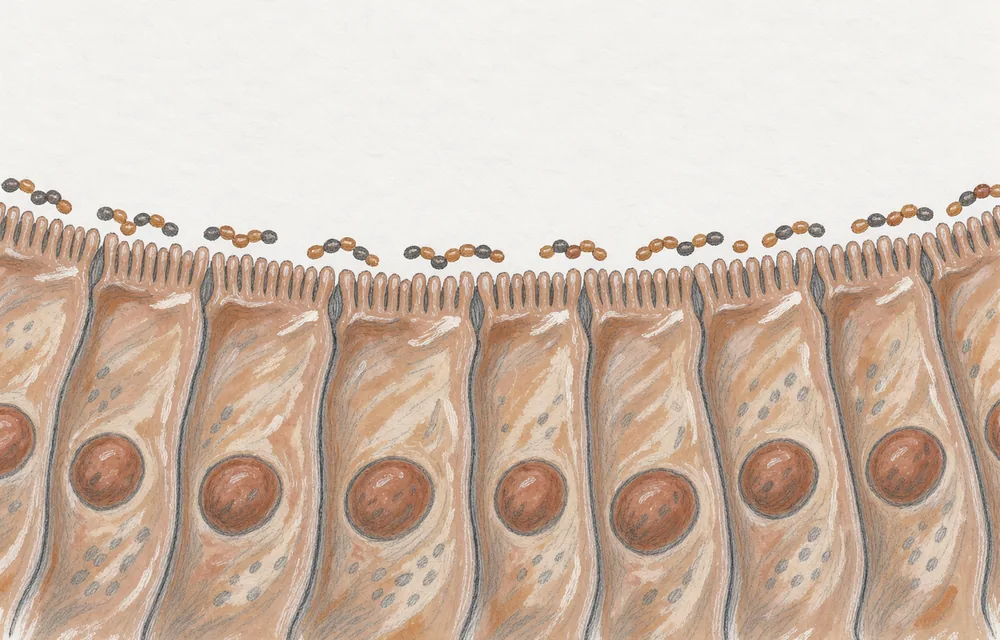
The intestinal cell membrane is where KLOW earns my curiosity. The 2008 KPV study identified uptake through PepT1, a transporter that carries small peptides into cells. In cultured human intestinal epithelial and immune cells, nanomolar KPV reduced NF-kB and MAPK inflammatory signaling and cytokine secretion. Oral KPV also reduced the severity of experimentally induced colitis in mice.
That's a specific chain of events: a small peptide, a route into a cell, altered inflammatory signaling, and a separate animal result. The human cells were in culture; the colitis subjects were mice. I appreciate the PepT1 experiment for tracing uptake before drawing conclusions about inflammation.
KPV is the extra ingredient that distinguishes KLOW from GLOW. Whether its uptake finding carries into a co-formulated blend given by a different route remains unanswered. The experiment tested KPV, without the other KLOW ingredients.
What is in KLOW?
KLOW combines KPV, GHK-Cu, BPC-157 and TB-500. Common research descriptions list GHK-Cu 50 mg, BPC-157 10 mg, TB-500 10 mg and KPV 10 mg, for an 80 mg total. These are composition figures on research labels; they establish no human dose or regimen. The four molecules remain separate in the mixture.
GHK-Cu, sometimes compressed to GHKCU or written GHK CU, is the copper-carrying constituent. Its skin-regeneration review describes collagen and other matrix components. BPC-157 contributes vessel-growth findings from chick, rat and cultured human vascular-cell models. TB-500 is the short fragment whose reputation relies heavily on full-length thymosin beta-4 research.
Four ingredients make an appealing inventory of tasks. The blend's performance as a unit still needs to be measured.
KLOW community effects
Community accounts describe easing joint or tendon discomfort, less general achiness, improved gut comfort and smoother-looking skin. Others describe injection-site redness, swelling or itching, fatigue, headache, flushing, nausea or no noticeable effect. These accounts are anecdotal, not clinical evidence; the material and the circumstances are unverified.
My skepticism sharpens when the same account assigns its gut change to KPV and its skin change to GHK-Cu. That division sounds plausible because it echoes the ingredient literature. An uncontrolled account of a mixture cannot tell which component caused which change.
The distinction becomes especially consequential in comparisons with Wolverine. No controlled study has shown that KLOW's extra ingredients improve outcomes over the shared BPC-157 and TB-500 core. The Sports Medicine review documents the wider shortage of rigorous human safety evidence.
Is KLOW peptide third party tested?
The papers cited here do not verify the identity, purity or proportions of a particular KLOW preparation. A statement about third party testing requires documentation for that material. The 2026 review's account of products outside regulatory oversight is relevant to that uncertainty; it cannot certify a batch.
Even accurate chemical analysis would answer a different question from a controlled blend trial. Identity and purity concern what is present. Clinical studies concern what happens when people receive it. Chemical testing earns its place here by identifying the preparation; my question about clinical outcomes stays unanswered.
Copper and combination safety
KLOW has no FDA approval, and no controlled combination study establishes its safety or efficacy. BPC-157 and TB-500 are prohibited by WADA. The current safety review cautions that animal-model promise coexists with scarce human safety data and potential for serious harm.
GHK-Cu's copper chemistry creates a specific theoretical concern in copper-handling disorders such as Wilson's disease. The GHK-Cu literature describes its copper-dependent and cellular actions, without establishing safety of the KLOW mixture in that population. Compatibility of the copper complex with the other peptides and the mixture's combined pharmacokinetics remain uncharacterized.
KPV's suppression of inflammatory signaling raises mechanistic questions in active infection and autoimmune disease. The pro-angiogenic constituent findings also raise a theoretical concern around active or recent cancer. These concerns call attention to missing human data; they are not demonstrated clinical harms from KLOW.
The ingredient comparison makes the shared core easy to locate. It offers no basis for treating a longer ingredient list as a safety advantage.